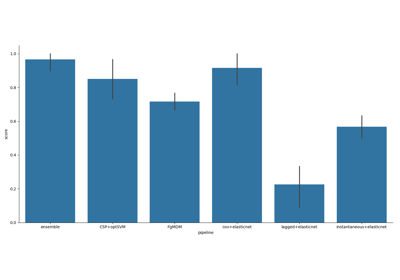
pyriemann.classification.FgMDM
- class pyriemann.classification.FgMDM(metric='riemann', tsupdate=False, n_jobs=1)
Classification by Minimum Distance to Mean with geodesic filtering.
Apply geodesic filtering described in [1], and classify using MDM. The geodesic filtering is achieved in tangent space with a Linear Discriminant Analysis, then data are projected back to the manifold and classifier with a regular MDM. This is basically a pipeline of FGDA and MDM.
- Parameters:
- metricstring | dict, default=”riemann”
Metric used for reference matrix estimation (for the list of supported metrics, see
pyriemann.utils.mean.mean_covariance()), for distance estimation (seepyriemann.utils.distance.distance()) and for tangent space map (seepyriemann.utils.tangent_space.tangent_space()). The metric can be a dict with three keys, “mean”, “dist” and “map” in order to pass different metrics.- tsupdatebool, default=False
Activate tangent space update for covariante shift correction between training and test, as described in [2]. This is not compatible with online implementation. Performance are better when the number of matrices for prediction is higher.
- n_jobsint, default=1
Number of jobs to use for the computation. This works by computing each of the class centroid in parallel. If -1 all CPUs are used. If 1 is given, no parallel computing code is used at all, which is useful for debugging. For n_jobs below -1, (n_cpus + 1 + n_jobs) are used. Thus for n_jobs = -2, all CPUs but one are used.
- Attributes:
- classes_ndarray, shape (n_classes,)
Labels for each class.
See also
MDMFGDATangentSpace
References
[1]Riemannian geometry applied to BCI classification A. Barachant, S. Bonnet, M. Congedo and C. Jutten. 9th International Conference Latent Variable Analysis and Signal Separation (LVA/ICA 2010), LNCS vol. 6365, 2010, p. 629-636.
[2]Classification of covariance matrices using a Riemannian-based kernel for BCI applications A. Barachant, S. Bonnet, M. Congedo and C. Jutten. Neurocomputing, Elsevier, 2013, 112, pp.172-178.
- __init__(metric='riemann', tsupdate=False, n_jobs=1)
Init.
- fit(X, y, sample_weight=None)
Fit FgMDM.
- Parameters:
- Xndarray, shape (n_matrices, n_channels, n_channels)
Set of SPD matrices.
- yndarray, shape (n_matrices,)
Labels for each matrix.
- sample_weightNone | ndarray, shape (n_matrices,), default=None
Weights for each matrix. If None, it uses equal weights.
- Returns:
- selfFgMDM instance
The FgMDM instance.
- fit_transform(X, y=None, sample_weight=None)
Fit and transform in a single function.
- Parameters:
- Xndarray, shape (n_matrices, n_channels, n_channels)
Set of SPD matrices.
- yNone | ndarray, shape (n_matrices,), default=None
Labels for each matrix.
- sample_weightNone | ndarray, shape (n_matrices,), default=None
Weights for each matrix. If None, it uses equal weights.
- Returns:
- distndarray, shape (n_matrices, n_centroids)
Distance to each centroid.
- get_metadata_routing()
Get metadata routing of this object.
Please check User Guide on how the routing mechanism works.
- Returns:
- routingMetadataRequest
A
MetadataRequestencapsulating routing information.
- get_params(deep=True)
Get parameters for this estimator.
- Parameters:
- deepbool, default=True
If True, will return the parameters for this estimator and contained subobjects that are estimators.
- Returns:
- paramsdict
Parameter names mapped to their values.
- predict(X)
Get the predictions after FGDA filtering.
- Parameters:
- Xndarray, shape (n_matrices, n_channels, n_channels)
Set of SPD matrices.
- Returns:
- predndarray of int, shape (n_matrices,)
Predictions for each matrix according to the nearest centroid.
- predict_proba(X)
Predict proba using softmax after FGDA filtering.
- Parameters:
- Xndarray, shape (n_matrices, n_channels, n_channels)
Set of SPD matrices.
- Returns:
- probndarray, shape (n_matrices, n_classes)
The softmax probabilities for each class.
- score(X, y, sample_weight=None)
Return the mean accuracy on the given test data and labels.
- Parameters:
- Xndarray, shape (n_matrices, n_channels, n_channels)
Test set of SPD matrices.
- yndarray, shape (n_matrices,)
True labels for each matrix.
- sample_weightNone | ndarray, shape (n_matrices,), default=None
Weights for each matrix.
- Returns:
- scorefloat
Mean accuracy of clf.predict(X) wrt. y.
- set_fit_request(*, sample_weight: bool | None | str = '$UNCHANGED$') FgMDM
Configure whether metadata should be requested to be passed to the
fitmethod.Note that this method is only relevant when this estimator is used as a sub-estimator within a meta-estimator and metadata routing is enabled with
enable_metadata_routing=True(seesklearn.set_config()). Please check the User Guide on how the routing mechanism works.The options for each parameter are:
True: metadata is requested, and passed tofitif provided. The request is ignored if metadata is not provided.False: metadata is not requested and the meta-estimator will not pass it tofit.None: metadata is not requested, and the meta-estimator will raise an error if the user provides it.str: metadata should be passed to the meta-estimator with this given alias instead of the original name.
The default (
sklearn.utils.metadata_routing.UNCHANGED) retains the existing request. This allows you to change the request for some parameters and not others.Added in version 1.3.
- Parameters:
- sample_weightstr, True, False, or None, default=sklearn.utils.metadata_routing.UNCHANGED
Metadata routing for
sample_weightparameter infit.
- Returns:
- selfobject
The updated object.
- set_output(*, transform=None)
Set output container.
See Introducing the set_output API for an example on how to use the API.
- Parameters:
- transform{“default”, “pandas”, “polars”}, default=None
Configure output of transform and fit_transform.
“default”: Default output format of a transformer
“pandas”: DataFrame output
“polars”: Polars output
None: Transform configuration is unchanged
Added in version 1.4: “polars” option was added.
- Returns:
- selfestimator instance
Estimator instance.
- set_params(**params)
Set the parameters of this estimator.
The method works on simple estimators as well as on nested objects (such as
Pipeline). The latter have parameters of the form<component>__<parameter>so that it’s possible to update each component of a nested object.- Parameters:
- **paramsdict
Estimator parameters.
- Returns:
- selfestimator instance
Estimator instance.
- set_score_request(*, sample_weight: bool | None | str = '$UNCHANGED$') FgMDM
Configure whether metadata should be requested to be passed to the
scoremethod.Note that this method is only relevant when this estimator is used as a sub-estimator within a meta-estimator and metadata routing is enabled with
enable_metadata_routing=True(seesklearn.set_config()). Please check the User Guide on how the routing mechanism works.The options for each parameter are:
True: metadata is requested, and passed toscoreif provided. The request is ignored if metadata is not provided.False: metadata is not requested and the meta-estimator will not pass it toscore.None: metadata is not requested, and the meta-estimator will raise an error if the user provides it.str: metadata should be passed to the meta-estimator with this given alias instead of the original name.
The default (
sklearn.utils.metadata_routing.UNCHANGED) retains the existing request. This allows you to change the request for some parameters and not others.Added in version 1.3.
- Parameters:
- sample_weightstr, True, False, or None, default=sklearn.utils.metadata_routing.UNCHANGED
Metadata routing for
sample_weightparameter inscore.
- Returns:
- selfobject
The updated object.
- transform(X)
Get the distance to each centroid after FGDA filtering.
- Parameters:
- Xndarray, shape (n_matrices, n_channels, n_channels)
Set of SPD matrices.
- Returns:
- distndarray, shape (n_matrices, n_classes)
Distance to each centroid according to the metric.