pyriemann.spatialfilters.AJDC
- class pyriemann.spatialfilters.AJDC(window=128, overlap=0.5, fmin=None, fmax=None, fs=None, dim_red=None, verbose=True)
AJDC algorithm.
The approximate joint diagonalization of Fourier cospectral matrices (AJDC) [1] is a versatile tool for blind source separation (BSS) tasks based on Second-Order Statistics (SOS), estimating spectrally uncorrelated sources.
It can be applied:
on a single subject, to solve the classical BSS problem [1],
on several subjects, to solve the group BSS (gBSS) problem [2],
on several experimental conditions (for eg, baseline versus task), to exploit the diversity of source energy between conditions in addition to generic coloration and time-varying energy [1].
AJDC estimates Fourier cospectral matrices by the Welch’s method, and applies a trace-normalization. If necessary, it averages cospectra across subjects, and concatenates them along experimental conditions. Then, a dimension reduction and a whitening are applied on cospectra. An approximate joint diagonalization (AJD) [3] allows to estimate the joint diagonalizer, not constrained to be orthogonal. Finally, forward and backward spatial filters are computed.
- Parameters:
- windowint, default=128
The length of the FFT window used for spectral estimation.
- overlapfloat, default=0.5
The percentage of overlap between window.
- fminfloat | None, default=None
The minimal frequency to be returned. Since BSS models assume zero-mean processes, the first cospectrum (0 Hz) must be excluded.
- fmaxfloat | None, default=None
The maximal frequency to be returned.
- fsfloat | None, default=None
The sampling frequency of the signal.
- dim_redNone | dict, default=None
Parameter for dimension reduction of cospectra, because Pham’s AJD is sensitive to matrices conditioning.
- If
None: no dimension reduction during whitening.
- If
{"n_components": val}: dimension reduction defining the number of components;
valmust be an integer superior to 1.- If
{"expl_var": val}: dimension reduction selecting the number of components such that the amount of variance that needs to be explained is greater than the percentage specified by
val.valmust be a float in (0,1], typically0.99.- If
{"max_cond": val}: dimension reduction selecting the number of components such that the condition number of the mean matrix is lower than
val. This threshold has a physiological interpretation, because it can be viewed as the ratio between the power of the strongest component (usually, eye-blink source) and the power of the lowest component you don’t want to keep (acquisition sensor noise).valmust be a float strictly superior to 1, typically 100.- If
{"warm_restart": val}: dimension reduction defining the number of components from an initial joint diagonalizer, and then run AJD from this solution.
valmust be a square ndarray.
- If
- verbosebool, default=True
Verbose flag.
- Attributes:
- n_channels_int
If fit, the number of channels of the signal.
- freqs_ndarray, shape (n_freqs,)
If fit, the frequencies associated to cospectra.
- n_sources_int
If fit, the number of components of the source space.
- diag_filters_ndarray, shape
(n_sources_, n_sources_) If fit, the diagonalization filters, also called joint diagonalizer.
- forward_filters_ndarray, shape
(n_sources_, n_channels_) If fit, the spatial filters used to transform signal into source, also called deximing or separating matrix.
- backward_filters_ndarray, shape
(n_channels_, n_sources_) If fit, the spatial filters used to transform source into signal, also called mixing matrix.
See also
CoSpectra
Notes
Added in version 0.2.7.
References
[1] (1,2,3)On the blind source separation of human electroencephalogram by approximate joint diagonalization of second order statistics M. Congedo, C. Gouy-Pailler, C. Jutten. Clinical Neurophysiology, Elsevier, 2008, 119 (12), pp.2677-2686.
[2]Group indepedent component analysis of resting state EEG in large normative samples M. Congedo, R. John, D. de Ridder, L. Prichep. International Journal of Psychophysiology, Elsevier, 2010, 78, pp.89-99.
[3]Joint approximate diagonalization of positive definite Hermitian matrices D.-T. Pham. SIAM Journal on Matrix Analysis and Applications, Volume 22 Issue 4, 2000
- __init__(window=128, overlap=0.5, fmin=None, fmax=None, fs=None, dim_red=None, verbose=True)
Init.
- fit(X, y=None)
Fit.
Compute and diagonalize cospectra, to estimate forward and backward spatial filters.
- Parameters:
- Xndarray, shape (n_subjects, n_conditions, n_channels, n_times) | list of n_subjects of list of n_conditions ndarray of shape (n_channels, n_times), with same n_conditions and n_channels but different n_times
Multi-channel time-series in channel space, acquired for different subjects and under different experimental conditions.
- yNone
Currently not used, here for compatibility with sklearn API.
- Returns:
- selfAJDC instance
The AJDC instance.
- fit_transform(**kwargs)
Warning
DEPRECATED: fit_transform() is deprecated and will be removed in 0.11.0; please use fit().transform().
- get_metadata_routing()
Get metadata routing of this object.
Please check User Guide on how the routing mechanism works.
- Returns:
- routingMetadataRequest
A
MetadataRequestencapsulating routing information.
- get_params(deep=True)
Get parameters for this estimator.
- Parameters:
- deepbool, default=True
If True, will return the parameters for this estimator and contained subobjects that are estimators.
- Returns:
- paramsdict
Parameter names mapped to their values.
- get_src_expl_var(X)
Estimate explained variances of sources.
Estimate explained variances of sources, see Appendix D in [1].
- Parameters:
- Xndarray, shape (n_matrices, n_channels, n_times)
Multi-channel time-series in channel space.
- Returns:
- src_varndarray, shape (n_matrices, n_sources)
Explained variance for each source.
- inverse_transform(X, supp=None)
Transform source space to channel space.
Transform source space to channel space, applying backward spatial filters, with the possibility to suppress some sources, like in BSS filtering/denoising.
- Parameters:
- Xndarray, shape (n_matrices, n_sources, n_times)
Multi-channel time-series in source space.
- supplist of int | None, default=None
Indices of sources to suppress. If None, no source suppression.
- Returns:
- X_newndarray, shape (n_matrices, n_channels, n_times)
Multi-channel time-series in channel space.
- set_inverse_transform_request(*, supp: bool | None | str = '$UNCHANGED$') AJDC
Configure whether metadata should be requested to be passed to the
inverse_transformmethod.Note that this method is only relevant when this estimator is used as a sub-estimator within a meta-estimator and metadata routing is enabled with
enable_metadata_routing=True(seesklearn.set_config()). Please check the User Guide on how the routing mechanism works.The options for each parameter are:
True: metadata is requested, and passed toinverse_transformif provided. The request is ignored if metadata is not provided.False: metadata is not requested and the meta-estimator will not pass it toinverse_transform.None: metadata is not requested, and the meta-estimator will raise an error if the user provides it.str: metadata should be passed to the meta-estimator with this given alias instead of the original name.
The default (
sklearn.utils.metadata_routing.UNCHANGED) retains the existing request. This allows you to change the request for some parameters and not others.Added in version 1.3.
- Parameters:
- suppstr, True, False, or None, default=sklearn.utils.metadata_routing.UNCHANGED
Metadata routing for
suppparameter ininverse_transform.
- Returns:
- selfobject
The updated object.
- set_params(**params)
Set the parameters of this estimator.
The method works on simple estimators as well as on nested objects (such as
Pipeline). The latter have parameters of the form<component>__<parameter>so that it’s possible to update each component of a nested object.- Parameters:
- **paramsdict
Estimator parameters.
- Returns:
- selfestimator instance
Estimator instance.
- transform(X)
Transform channel space to source space.
Transform channel space to source space, applying forward spatial filters.
- Parameters:
- Xndarray, shape (n_matrices, n_channels, n_times)
Multi-channel time-series in channel space.
- Returns:
- X_newndarray, shape (n_matrices, n_sources, n_times)
Multi-channel time-series in source space.
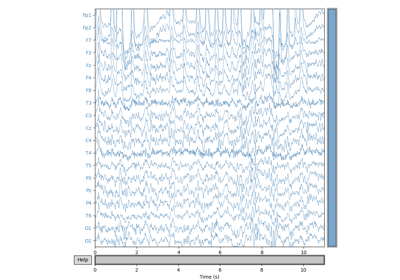
Examples using pyriemann.spatialfilters.AJDC
Artifact Correction by AJDC-based Blind Source Separation