pyriemann.artifact_detection.PotatoField
- class pyriemann.artifact_detection.PotatoField(n_potatoes=1, p_threshold=0.01, z_threshold=3, metric='riemann', n_iter_max=10, pos_label=1, neg_label=0, method_combination='fisher')[source]
Artifact detection with the Riemannian Potato Field.
The Riemannian Potato Field [1] is a clustering method used to detect artifact in multichannel signals. Processing SPD/HPD matrices, the algorithm combines several potatoes of low dimension, each one being designed to capture specific artifact typically affecting specific subsets of channels and/or specific frequency bands.
- Parameters:
- n_potatoesint, default=1
Number of potatoes in the field.
- p_thresholdfloat, default=0.01
Threshold on probability to being clean, in (0, 1), combining probabilities of potatoes using
method_combination.- z_thresholdfloat, default=3
Threshold on z-score of distance to reject artifacts. It is the number of standard deviations from the mean of distances to the centroid.
- metricstring | dict | list, default=”riemann”
Metric used for mean estimation (for the list of supported metrics, see
pyriemann.geometry.mean.gmean()) and for distance estimation (seepyriemann.geometry.distance.distance()). The metric can be a single str; or a dict with two keys, “mean” and “distance”, in order to pass different metrics for mean and distance; or a list ofn_potatoesstr or dict, in order to pass different metrics for each potato [2].Changed in version 0.11: Allow a different metric per potato.
- n_iter_maxint, default=10
The maximum number of iteration to reach convergence.
- pos_labelint, default=1
The positive label corresponding to clean data.
- neg_labelint, default=0
The negative label corresponding to artifact data.
- method_combination{“fisher”, “stouffer”} | callable, default=”fisher”
Method to combine probabilities from the different potatoes:
fisher: Fisher’s method;
stouffer: Stouffer’s z-score method;
callable: for a custom combination function, with an axis argument.
Added in version 0.11.
See also
Notes
Added in version 0.3.
Changed in version 0.12: Move from clustering to artifactdetection.
References
[1]The Riemannian Potato Field: A Tool for Online Signal Quality Index of EEG Q. Barthélemy, L. Mayaud, D. Ojeda, and M. Congedo. IEEE Transactions on Neural Systems and Rehabilitation Engineering, 2019
[2]Improved Riemannian potato field: an Automatic Artifact Rejection Method for EEG D. Hajhassani, Q. Barthélemy, J. Mattout & M. Congedo. Biomedical Signal Processing and Control, 2026
- __init__(n_potatoes=1, p_threshold=0.01, z_threshold=3, metric='riemann', n_iter_max=10, pos_label=1, neg_label=0, method_combination='fisher')[source]
Init.
- fit(X, y=None, sample_weight=None)[source]
Fit the potato field.
Fit the potato field from SPD/HPD matrices, with iterative outlier removal to obtain reliable potatoes.
- Parameters:
- Xlist of n_potatoes ndarrays of shape (n_matrices, n_channels, n_channels) with same n_matrices but potentially different n_channels
List of sets of SPD/HPD matrices, each corresponding to a different subset of channels and/or filtering with a specific frequency band.
- yNone | ndarray, shape (n_matrices,), default=None
Labels corresponding to each matrix: positive (resp. negative) label corresponds to a clean (resp. artifact) matrix. If None, all matrices are considered as clean.
- sample_weightNone | ndarray, shape (n_matrices,), default=None
Weights for each matrix. If None, it uses equal weights.
- Returns:
- selfPotatoField instance
The PotatoField instance.
- fit_transform(X, y=None, sample_weight=None)[source]
Fit and transform in a single function.
- Parameters:
- Xlist of n_potatoes ndarrays of shape (n_matrices, n_channels, n_channels) with same n_matrices but potentially different n_channels
List of sets of SPD/HPD matrices, each corresponding to a different subset of channels and/or filtering with a specific frequency band.
- yNone | ndarray, shape (n_matrices,), default=None
Labels corresponding to each matrix: positive (resp. negative) label corresponds to a clean (resp. artifact) matrix. If None, all matrices are considered as clean.
- sample_weightNone | ndarray, shape (n_matrices,), default=None
Weights for each matrix. If None, it uses equal weights.
- Returns:
- zndarray, shape (n_matrices, n_potatoes)
Standardized log-distances to the centroids.
- get_metadata_routing()
Get metadata routing of this object.
Please check User Guide on how the routing mechanism works.
- Returns:
- routingMetadataRequest
A
MetadataRequestencapsulating routing information.
- get_params(deep=True)
Get parameters for this estimator.
- Parameters:
- deepbool, default=True
If True, will return the parameters for this estimator and contained subobjects that are estimators.
- Returns:
- paramsdict
Parameter names mapped to their values.
- partial_fit(X, y=None, *, sample_weight=None, alpha=0.1)[source]
Partially fit the potato field.
This partial fit can be used to update dynamic or semi-dymanic online potatoes with clean matrices.
- Parameters:
- Xlist of n_potatoes ndarrays of shape (n_matrices, n_channels, n_channels) with same n_matrices but potentially different n_channels
List of sets of SPD/HPD matrices, each corresponding to a different subset of channels and/or filtering with a specific frequency band.
- yNone | ndarray, shape (n_matrices,), default=None
Labels corresponding to each matrix: positive (resp. negative) label corresponds to a clean (resp. artifact) matrix. If None, all matrices are considered as clean.
- sample_weightNone | ndarray, shape (n_matrices,), default=None
Weights for each matrix. If None, it uses equal weights.
- alphafloat, default=0.1
Update rate in [0, 1] for the centroid, and mean and standard deviation of log-distances: 0 for no update, 1 for full update.
- Returns:
- selfPotatoField instance
The PotatoField instance.
- predict(X)[source]
Predict artifact from data.
- Parameters:
- Xlist of n_potatoes ndarrays of shape (n_matrices, n_channels, n_channels) with same n_matrices but potentially different n_channels
List of sets of SPD/HPD matrices, each corresponding to a different subset of channels and/or filtering with a specific frequency band.
- Returns:
- predndarray of bool, shape (n_matrices,)
The artifact detection: True if the matrix is clean, and False if the matrix contains an artifact.
- predict_proba(X)[source]
Predict probability combining probabilities of potatoes.
Predict probability combining probabilities of the different potatoes using
method_combination. With Fisher’s method, a threshold of 0.01 can be used.- Parameters:
- Xlist of n_potatoes ndarrays of shape (n_matrices, n_channels, n_channels) with same n_matrices but potentially different n_channels
List of sets of SPD/HPD matrices, each corresponding to a different subset of channels and/or filtering with a specific frequency band.
- Returns:
- probandarray, shape (n_matrices,)
Matrix is considered as normal/clean for high value of proba. It is considered as abnormal/artifacted for low value of proba.
- score(X, y, sample_weight=None)
Return the mean accuracy on the given test data and labels.
- Parameters:
- Xndarray, shape (n_matrices, n_channels, n_channels)
Test set of SPD matrices.
- yndarray, shape (n_matrices,)
True labels for each matrix.
- sample_weightNone | ndarray, shape (n_matrices,), default=None
Weights for each matrix.
- Returns:
- scorefloat
Mean accuracy of clf.predict(X) wrt. y.
- set_fit_request(*, sample_weight: bool | None | str = '$UNCHANGED$') PotatoField
Configure whether metadata should be requested to be passed to the
fitmethod.Note that this method is only relevant when this estimator is used as a sub-estimator within a meta-estimator and metadata routing is enabled with
enable_metadata_routing=True(seesklearn.set_config()). Please check the User Guide on how the routing mechanism works.The options for each parameter are:
True: metadata is requested, and passed tofitif provided. The request is ignored if metadata is not provided.False: metadata is not requested and the meta-estimator will not pass it tofit.None: metadata is not requested, and the meta-estimator will raise an error if the user provides it.str: metadata should be passed to the meta-estimator with this given alias instead of the original name.
The default (
sklearn.utils.metadata_routing.UNCHANGED) retains the existing request. This allows you to change the request for some parameters and not others.Added in version 1.3.
- Parameters:
- sample_weightstr, True, False, or None, default=sklearn.utils.metadata_routing.UNCHANGED
Metadata routing for
sample_weightparameter infit.
- Returns:
- selfobject
The updated object.
- set_output(*, transform=None)
Set output container.
See Introducing the set_output API for an example on how to use the API.
- Parameters:
- transform{“default”, “pandas”, “polars”}, default=None
Configure output of transform and fit_transform.
“default”: Default output format of a transformer
“pandas”: DataFrame output
“polars”: Polars output
None: Transform configuration is unchanged
Added in version 1.4: “polars” option was added.
- Returns:
- selfestimator instance
Estimator instance.
- set_params(**params)
Set the parameters of this estimator.
The method works on simple estimators as well as on nested objects (such as
Pipeline). The latter have parameters of the form<component>__<parameter>so that it’s possible to update each component of a nested object.- Parameters:
- **paramsdict
Estimator parameters.
- Returns:
- selfestimator instance
Estimator instance.
- set_partial_fit_request(*, alpha: bool | None | str = '$UNCHANGED$', sample_weight: bool | None | str = '$UNCHANGED$') PotatoField
Configure whether metadata should be requested to be passed to the
partial_fitmethod.Note that this method is only relevant when this estimator is used as a sub-estimator within a meta-estimator and metadata routing is enabled with
enable_metadata_routing=True(seesklearn.set_config()). Please check the User Guide on how the routing mechanism works.The options for each parameter are:
True: metadata is requested, and passed topartial_fitif provided. The request is ignored if metadata is not provided.False: metadata is not requested and the meta-estimator will not pass it topartial_fit.None: metadata is not requested, and the meta-estimator will raise an error if the user provides it.str: metadata should be passed to the meta-estimator with this given alias instead of the original name.
The default (
sklearn.utils.metadata_routing.UNCHANGED) retains the existing request. This allows you to change the request for some parameters and not others.Added in version 1.3.
- Parameters:
- alphastr, True, False, or None, default=sklearn.utils.metadata_routing.UNCHANGED
Metadata routing for
alphaparameter inpartial_fit.- sample_weightstr, True, False, or None, default=sklearn.utils.metadata_routing.UNCHANGED
Metadata routing for
sample_weightparameter inpartial_fit.
- Returns:
- selfobject
The updated object.
- set_score_request(*, sample_weight: bool | None | str = '$UNCHANGED$') PotatoField
Configure whether metadata should be requested to be passed to the
scoremethod.Note that this method is only relevant when this estimator is used as a sub-estimator within a meta-estimator and metadata routing is enabled with
enable_metadata_routing=True(seesklearn.set_config()). Please check the User Guide on how the routing mechanism works.The options for each parameter are:
True: metadata is requested, and passed toscoreif provided. The request is ignored if metadata is not provided.False: metadata is not requested and the meta-estimator will not pass it toscore.None: metadata is not requested, and the meta-estimator will raise an error if the user provides it.str: metadata should be passed to the meta-estimator with this given alias instead of the original name.
The default (
sklearn.utils.metadata_routing.UNCHANGED) retains the existing request. This allows you to change the request for some parameters and not others.Added in version 1.3.
- Parameters:
- sample_weightstr, True, False, or None, default=sklearn.utils.metadata_routing.UNCHANGED
Metadata routing for
sample_weightparameter inscore.
- Returns:
- selfobject
The updated object.
- transform(X)[source]
Return the standardized log-distances to the centroids.
Return the standardized log-distances to the centroids, ie geometric z-scores of distances.
- Parameters:
- Xlist of n_potatoes ndarrays of shape (n_matrices, n_channels, n_channels) with same n_matrices but potentially different n_channels
List of sets of SPD/HPD matrices, each corresponding to a different subset of channels and/or filtering with a specific frequency band.
- Returns:
- zndarray, shape (n_matrices, n_potatoes)
Standardized log-distances to the centroids.
Examples using pyriemann.artifact_detection.PotatoField
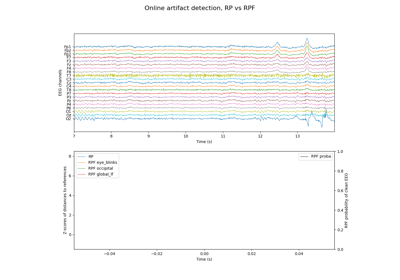
Online Artifact Detection with Riemannian Potato Field